
Garage Door Repair & Installation
Garage Door Motors Explained: Types, Lifespan and What Actually Breaks
Published 12 August 2026
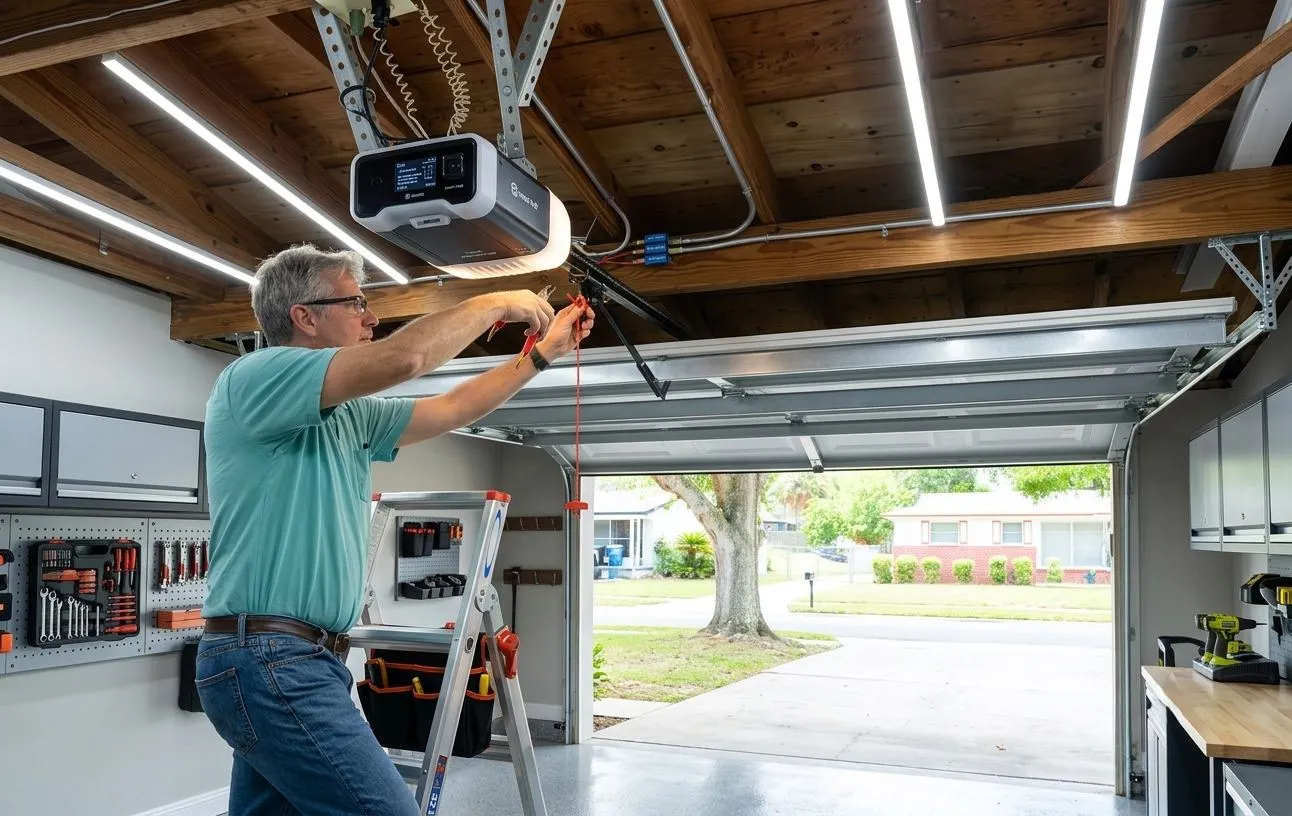
A garage door motor's job is simple in principle: it drives a trolley along a rail, and an arm connects that trolley to the top panel of the door, pulling it open or pushing it closed. Almost every residential motor sold in South Africa works this way, whether it's fitted to a sectional, tilt-up or roll-up door. The differences that actually matter to you are in the drive mechanism, the control board, and how the two fail.
There are three common drive types. Chain drive uses a metal chain to pull the trolley. It's durable and the cheapest option, but the noisiest, which matters if the garage is under a bedroom. Belt drive uses a reinforced rubber belt instead of a chain, quieter and slightly pricier, and the common choice for garages attached to living spaces. Screw drive uses a threaded steel rod, fewer moving parts and less maintenance, but performance can be more temperature-sensitive. None of the three is objectively 'best', it's a trade-off between noise, price and maintenance.
In South Africa, the motor brands we see most often on existing installs are Centurion, ET/ETI and Gemini, alongside a handful of European brands on newer or higher-end doors. Brand matters less than condition and whether parts are still available. A ten-year-old motor from a brand that's since changed its product line can be harder to source boards for than a cheaper but current model.
When a motor 'dies', it's rarely the motor unit itself. In order of how often we actually see it: control board faults (especially after power surges or repeated load shedding cycling), limit switch or sensor faults (the door reverses, or won't close fully), worn drive components (a slipping belt, a stretched chain), and least commonly, a genuinely burnt-out motor. That order matters for your wallet: a board replacement costs a fraction of a new motor unit, so it's worth having a fault properly diagnosed before agreeing to replace anything.
A well-maintained motor with an undamaged drive component and a healthy control board will often run well past ten years. What shortens that lifespan is less about age and more about conditions: unprotected power surges, a door that's out of balance and forcing the motor to work harder than it should, or dust and moisture getting into the control board housing.
If your garage is currently manual and you're adding a motor for the first time, the job includes fitting a mounting bracket and header, running the rail, and attaching the door arm. Critically, we also check the door's spring balance first. A motor fighting an unbalanced door will fail early no matter how good it is. Safety sensors (photo-eyes that stop the door closing on an obstruction) are standard on any modern install and shouldn't be treated as optional.
If you're choosing between a repair and a full replacement, the honest questions to ask are: is the fault isolated to a part that's still available, is the door itself still in good structural condition, and does the cost of repeated repairs start approaching the cost of a new unit. A straight diagnosis before any quote is the only way to answer that properly, which is also why we don't quote parts sight-unseen.
Key points
- Chain, belt and screw drive trade off noise, price and maintenance, none is universally best
- Control boards fail far more often than the motor unit itself, especially through load shedding
- A well-maintained motor with a healthy board typically runs well past ten years
Ready to get this sorted?
Free quotes, no pressure. Tell us what's going on and we'll take it from there.